

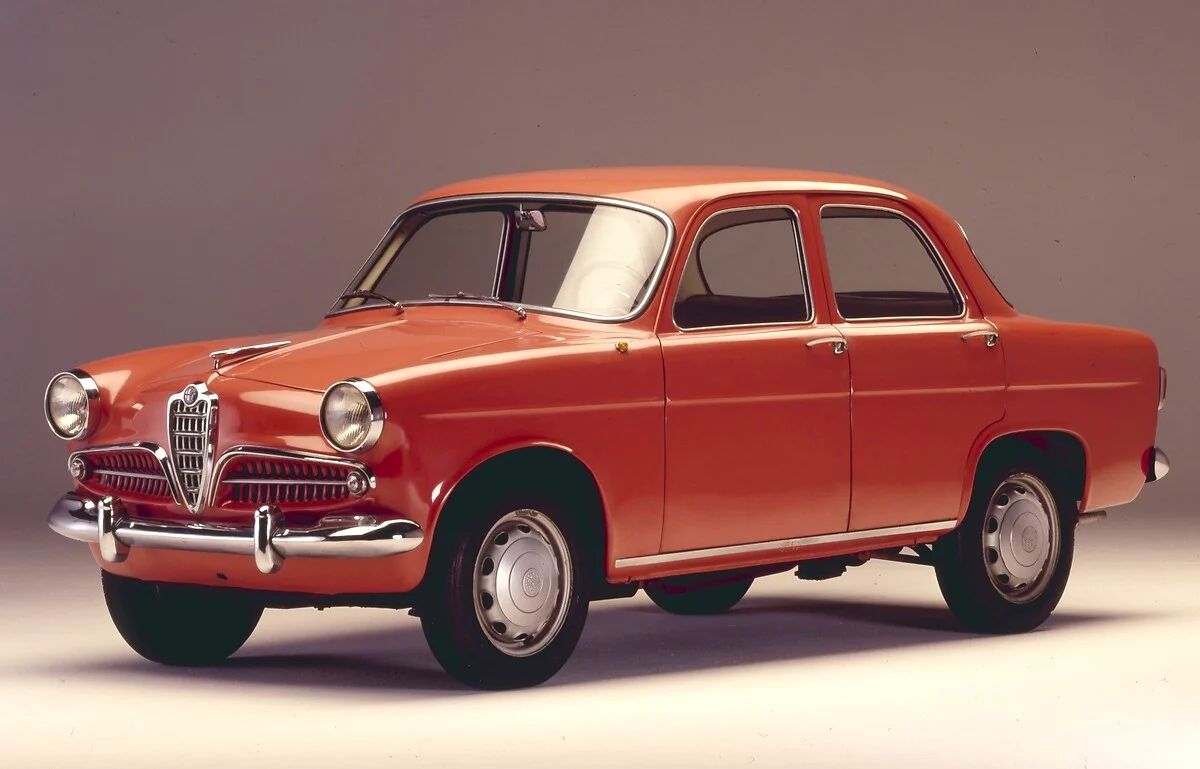
- Presented on April 20, 1955 at the Turin Motor Show, the Giulietta Berlina marked Alfa Romeo’s definitive transition from artisanal to industrial production, bringing style and sporting technology into the daily lives of Italians.
- With over 130,000 units produced between 1955 and 1964, the Giulietta Berlina redefined the concept of the mid-size car in Europe, effectively creating the category of high-performance premium compacts.
- Equipped with cutting-edge solutions for the time, including an innovative 1,290 cm³ all-aluminum twin-cam engine, the Giulietta was the first production sedan to feature such performance and mechanical characteristics.
- A true protagonist of Italian pop culture, the Giulietta appeared in cult films like I mostri by Dino Risi, on the first cover of Quattroruote in February 1956, and was celebrated by icons such as Giulietta Masina.
On April 20, 1955, at the Turin Motor Show, Alfa Romeo unveiled the Giulietta Berlina, a car destined to forever change the Italian automotive landscape. Elegant, technologically advanced, accessible, and with a sporty character, the Giulietta Berlina embodied the dream of an entire generation, becoming a symbol of the country’s rebirth as it entered the “economic boom.” Seventy years after that debut, Heritage Stellantis and Alfa Romeo celebrate a model that also marked the definitive transition from artisanal to industrial production. While the 1900 of 1950 paved the first path, it was the Giulietta that truly projected Alfa Romeo into the future, industrializing technical excellence and bringing it to a broader scale.
Roberto Giolito, Head of Heritage Stellantis, stated: “The Giulietta Berlina brought Alfa Romeo’s sporting DNA into the daily lives of Italians, making engineering and aspiration accessible to an emerging middle class. This model managed to blend the prestige of Alfa’s sports cars with the functionality of a family vehicle, establishing itself as a symbol of progress and rebirth in post-war Italy.”

In the early 1950s, Alfa Romeo—fresh off two consecutive Formula 1 world championships won with the Alfetta driven by Farina and Fangio in 1950 and 1951—felt the need to expand its production and reach a broader audience, while maintaining its style, technology, and performance. Thus was born the Giulietta project: a compact, modern, and accessible car that retained the refined and competitive spirit of Alfa’s vehicles. Surprisingly, the first to debut was not the sedan, but the coupé, the Giulietta Sprint, presented at the 1954 Turin Motor Show. Designed by Franco Scaglione for Bertone, the Sprint—a compact high-performance coupé with an engine under 1,500 cm³—was met with overwhelming enthusiasm. Notably, Scaglione was also the designer of the almost contemporary “2000 Sportiva,” the subsequent “Giulietta Sprint Speciale,” and the stunning “33 Stradale” of 1967. Riding on the success of the 1900, Alfa Romeo presented at the 1954 Turin Motor Show a compact coupé with superior performance, marking the company’s entry into a new category—compact cars with engines under 1,500 cc. It was also the first time that the coupé version of a new model was introduced before the sedan.
Charm and sportiness were thus at the heart of a car intended to build anticipation for the Giulietta Berlina, scheduled for release the following year, with an initially very limited production. However, the reception of the Giulietta Sprint changed everything: after the Turin Motor Show, Alfa Romeo dealerships were overwhelmed with demand, and within months the Sprint became a true commercial success, prompting Alfa to accelerate the sedan’s development. On April 20, 1955, the Giulietta Berlina made its debut: for the first time, a compact model with brilliant performance was offered in a family-friendly product package. Following the 1900, Alfa developed the concept of a sporty sedan in a more compact size. Alfa reaffirmed its motto, “the family car that wins races”: in the hands of gentlemen-drivers and future champions, it crossed the most prestigious finish lines, while, as a slogan of the time stated, “even mom drives it.” Thus began a new era, with Alfa Romeo pioneering the concept of “sports driving pleasure made accessible to all.”

It can be said that the Giulietta created a new class, that of 1300 cc displacement cars, which quickly became a European formula. In 1955, there was no other production sedan in the world with the mechanical characteristics and performance of the Giulietta. That’s why it became a benchmark. Despite the years, this model still retains a strong personality, reaffirming Alfa Romeo’s proud tradition. In particular, its design—developed by the Alfa Romeo Style Department—echoes the Sprint’s front-end elements, anticipating the future aesthetic identity of the brand, what we now call “family feeling.” Technically advanced, the Giulietta Berlina featured groundbreaking solutions for the time. For instance, under the hood was a 1,290 cm³ inline four-cylinder twin-cam engine producing 53 HP and reaching a top speed of 140 km/h—an exceptional result at the time, made possible also by its low weight of just 870 kg. The refined engine was made entirely of aluminum (a first in mass-produced cars), as were the gearbox and differential housings; the cylinder sleeves were cast in special iron; it had double overhead camshafts (unique for small-displacement engines of the era) and a crankshaft mounted on five main bearings.
With rear-wheel drive, the car also featured a column-mounted shifter (a floor-mounted lever became available from 1957 onward) and a pull-type handbrake located under the dashboard to the left of the steering wheel. The front suspension used independent wheels with coil springs, transverse wishbones, and a stabilizer bar; the rear had coil springs, an upper triangle, and trailing arms. Braking was handled by four drum brakes made using a special Alfa Romeo casting process.
It’s important to note that the Giulietta Berlina’s production marked an industrial turning point for Alfa Romeo. While the 1900 introduced series production, it was with the Giulietta that the Portello plant truly became a modern factory. In the early 1950s, the Milanese site still operated under artisanal production logic, producing no more than 50 cars a day. With the Giulietta, and with the input of Austrian engineer Rudolf Hruska, the entire process was rethought: new assembly lines were created, workflows reorganized, and production phases streamlined. Within a few years, Portello was producing up to 200 cars a day—quadrupling its capacity. This quantitative leap also represented a cultural shift: Alfa Romeo was no longer just an elite brand, but a major player in the European automotive industry.

The Giulietta also entered the Italian collective imagination, becoming a symbol of style and progress. It appeared in films like I mostri by Dino Risi, alongside cinema legends such as Marcello Mastroianni, Sophia Loren, and Vittorio Gassman. In 1960, the 100,001st unit was celebrated by Giulietta Masina, Fellini’s muse, cementing the bond between the car and Italian culture. A fun fact: the first cover of Quattroruote magazine, dated February 1956, was dedicated to the Giulietta Berlina—proof of its technical and symbolic significance. The name “Giulietta” itself adds to the legend, with two origin stories. One claims the suggestion came from Madame De Cousandier, wife of poet Leonardo Sinisgalli; the other tells of a Russian prince who, during a 1950 Paris event, quipped to Alfa Romeo executives: “There are eight Romeos, but not a single Giulietta?” Four years later, the answer arrived: the Giulietta Sprint. Over the years, it was joined by the Berlina, the Spider (designed by Pinin Farina for the US market, also available as the Veloce), the Sprint Speciale (again by Bertone), and the Giulietta SZ by Zagato. There was even a station wagon version called “Promiscua.” From 1954 to 1965, 177,690 Giuliettas were produced across all variants, more than 130,000 of which were Berlinas.
In short, with record-breaking performance, track-inspired road behavior, and unmistakable design, the Giulietta was not just a milestone in Alfa Romeo history, but a manifesto of Italian identity, capable of blending engineering and poetry, speed and grace, dreams and substance. Its legacy would later be carried on by the equally legendary Giulia in 1962, which refined the Giulietta’s virtues in terms of performance and innovation, continuing Alfa Romeo’s tradition of producing compact cars of superior category.
#AlfaRomeo #GiuliettaBerlina #70YearsGiulietta #ClassicCars #CarHistory #AlfaRomeoHeritage #ItalianCars
Instagram: @alfaromeoofficial @stellantis @fcaheritage @museoalfaromeo
Facebook: @alfaromeo @stellantis @FCAHeritage @MuseoAlfaRomeo
(photo courtesy of Stellantis Heritage Communications)